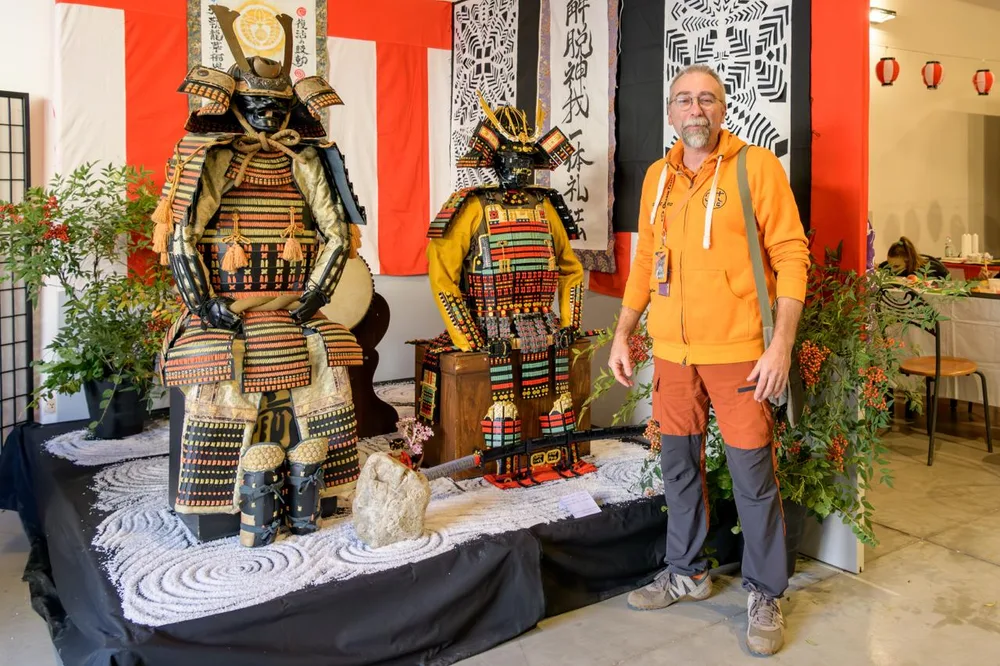

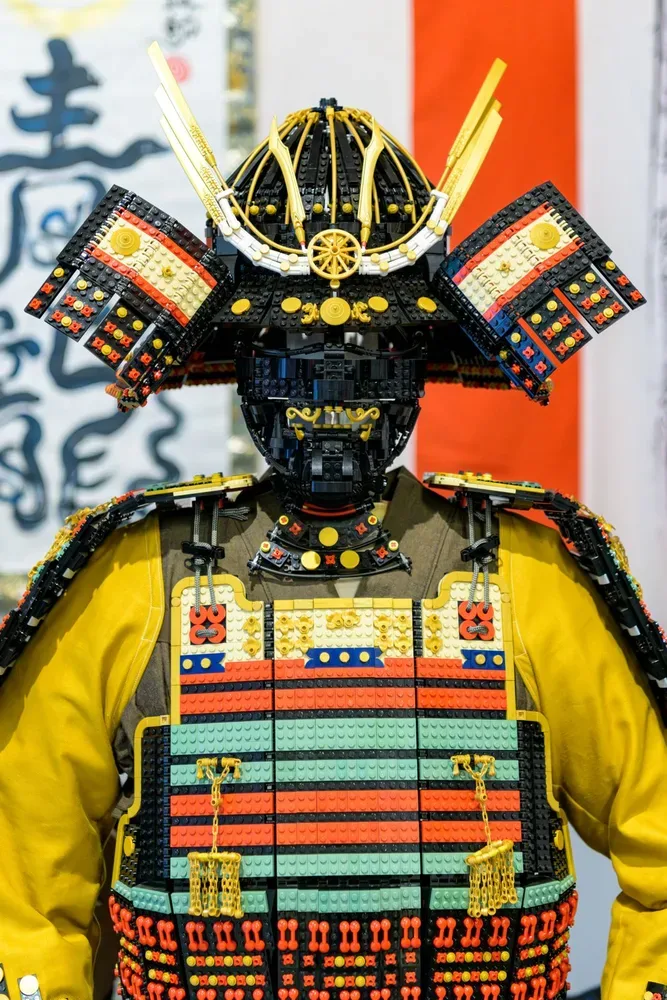

Andrea Montuori is a veteran LEGO MOC artist and master art restorer based in Florence, Italy, who approaches brick-building with the patience, precision, and discipline of an artisan craft. Operating entirely outside of digital trends, he is an analog builder who relies on hand-drawn sketches and uses pure, unmodified LEGO elements from various eras to create structurally complex masterpieces. His crowning achievement is the Armatura Samurai, a wearable, multi-year labor of love that perfectly balances historical form with exceptional functional strength.
LEGO building is often framed as a hobby. Perhaps a laidback way to pass a rainy afternoon. Or maybe to fill a display shelf. But for Andrea Montuori, a master craftsman in art restoration, it’s something that demands reverence, patience, and precision just like the pieces he restores in his professional life.
Nestled in the historic province of Florence, Italy — a region synonymous with the Renaissance masters — Montuori approaches bricks as a medium for true artisan craft. While many in the AFOL community today obsess over the latest digital renders or the next big release, this veteran MOC artist operates on a very different frequency.
He is a builder who exists outside of trends, working in the quiet hours of the night when the city falls into a slumber and the “dreamers,” as he calls them, finally have the space to create. His approach to brick-building is less about following instructions and more about pursuing creative freedom. Stepping into his studio, one would immediately sense the patience and discipline he brings to his craft.
A Dreamer in the Dark
For many, the journey into brick-building often begins with a specific set. For Montuori, it started at around age 10 with set 851 Tractor (Year Released: 1977; Pieces: 318; Retired). But the standard experience never quite satisfied him.
Even as a child, he felt a strong refusal to leave his sets exactly as the instructions dictated. Montuori wanted to modify them, to iterate, to adapt, and to make them distinctly his own and not another set his friends might have. In his words, he wanted them to be “produced by Lego, but different from the others.” This refusal to follow the path of least resistance and the compulsion for customization would later follow him into adulthood and define much of his creative life.
Montuori is a self-described analog builder who eschews digital design software entirely. Instead, he begins his projects with simple, hand-drawn sketches. He prefers to start the creation process with all of his doubts intact, embracing the uncertainty of the build and the tactile, sometimes messy process of analog creation as necessary parts of the artistic challenge.
“I don’t follow or chase any pattern,” Montuori explains. “I essentially build what I like, or what makes me curious.” This simple philosophy drives his journey. His method allows for a dialogue between the artist and the material — a conversation that often takes place in the quiet, atmospheric hours of the night. Of course, that doesn’t mean he’s closed off to the LEGO world; Montuori admits he has a soft spot for the Ninjago theme.
His workspace is his sanctuary. It is here that he catalogs his pieces with the meticulous nature of a restorer, surrounded by a shifting soundtrack of classical music and heavy metal. It is a space where he lets the real world fade away, and welcomes the one he knows will fuel his creativity.
The Architecture of the Armatura Samurai MOC
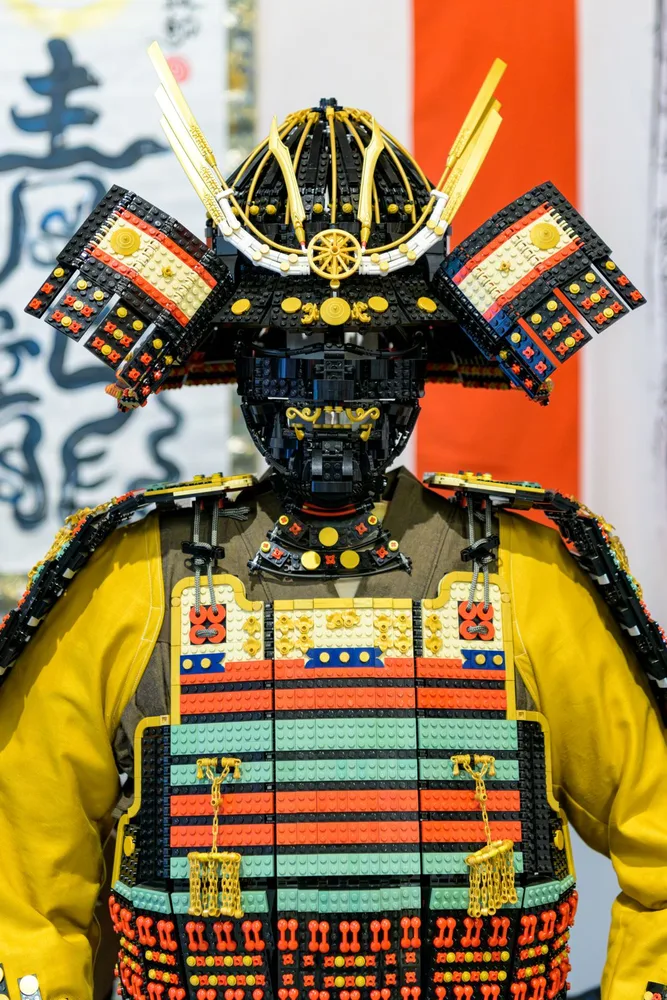
The crowning jewel of Montuori’s portfolio is his Armatura Samurai (Samurai Armor). The project was born not from a desire for internet clout, but from a heartfelt connection and a challenge issued by his friend, Seigo, for a Japanese festival. The request was simple yet daunting: could he reproduce a family’s traditional armor using only LEGO bricks?
Of course, the challenge was accepted, and the result was a multi-year labor of love. Montuori spent roughly 18 months on the armor and another six months meticulously crafting a removable, curved katana. To understand the genius of this build, one must understand his obsession with structural integrity. Andrea Montuori is a purist; he uses no glue, no custom-molded parts, and no modifications to the bricks themselves.
The build is a testament to his versatile talent and indomitable spirit. In it, he has used a palette that blends eras, incorporating pieces from the 60s, 80s, and today to achieve the perfect functional strength. The base uses black elements from the 1980s for their superior clutch power, while the central structure relies on vintage sleeper plates from 1960s train sets, which provide a foundation so rigid it can withstand the wear and tear of being worn (yes, the armor is wearable).
“The most particular technique is the use of hinges and 3mm rigid hoses,” he notes. These elements help create a structure that flexes and breathes with the wearer, mimicking the natural layering of traditional Japanese armor. Even the kabuto (helmet) is an exercise in tension — a delicate balance of pressure that keeps the structure stable under load, preventing a collapse.
His appreciation for the history of the brick is profound. When asked what he would want if he could have a lifetime supply of any specific resource, he doesn’t fixate on one modern element. Instead, he speaks with a collector’s passion about the beauty of the 1960s-era parts, noting that a lifelong, unlimited supply of those vintage pieces would be, in his words, ‘simply wonderful.’
Montuori’s Armatura Samurai is a stunning example of how a deep understanding of historical form, combined with an artistic eye, can transform a standard build into something truly organic.
Wisdom from the Workbench
When asked for advice for beginners who feel intimidated by the complexity of LEGO MOC building, Montuori is profoundly encouraging. He doesn’t suggest mastering a specific software or hunting for rare parts. Instead, he advocates for a deep, fundamental engagement with the craft.
He suggests that the best way to develop an eye for design is to build extensively with official sets — both the intricate detail of Creator and the mechanical logic of Technic. He believes this helps develop a “memory flash” for how different parts behave under stress.
Once the foundation is laid, he urges builders to dismantle, experiment, and pursue their own fascinations. “Don’t give up,” he says, with the intellect of someone who understands that creative failure is merely a stepping stone. “When in difficulty, ask for advice or help.” He also suggests that every serious MOC builder should become fluent in SNOT, Technic integration, OFFsetting, and SNIR.
Montuori isn’t afraid of a creative block, either. If he finds himself stuck on a MOC, he doesn’t force it; he simply steps away, sometimes for days. He turns his attention to a standard Technic set just to reset his mind, letting the frustration dissipate before returning to his project with fresh eyes.
He treats the build as a conversation; if the bricks aren’t talking back to him in the right way, he knows it’s time to listen to something else for a while. It is this balance of discipline and humility that makes his work so compelling.
A Legacy of Integrity
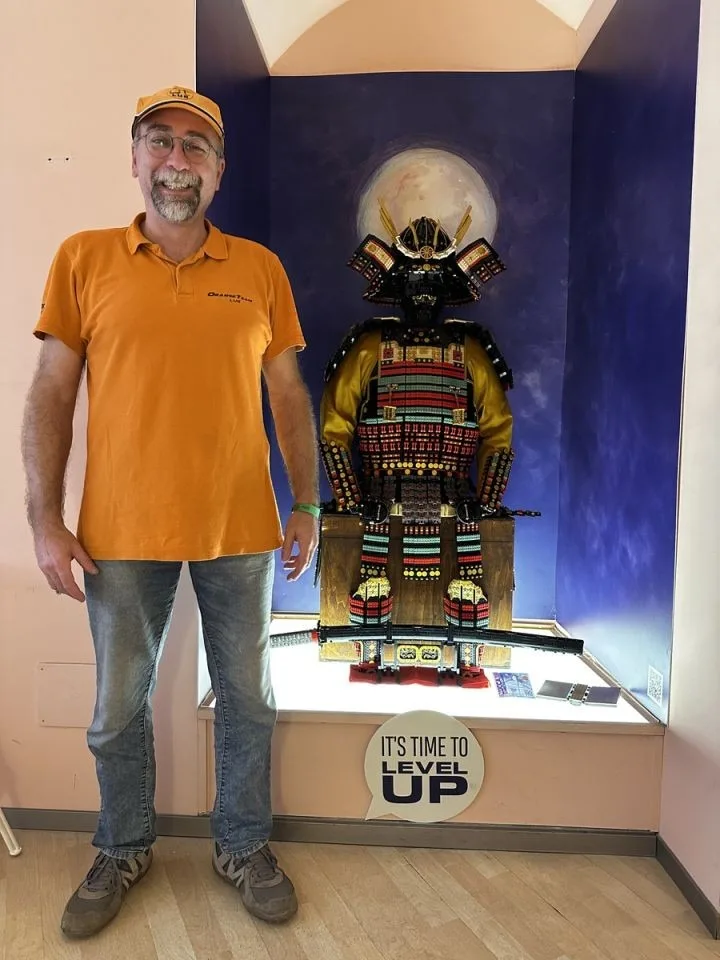
Artist Andrea Montuori’s work serves as a beautiful reminder of why we build. Where “custom” often implies cutting, gluing, or 3D-printing, his art stands as a bold defense of the classic LEGO system of building by hand. Builders who get lost in the pursuit of perfection can learn from his dedication to the craft, his patience to work through a model for months, and his humility to walk away when the work isn’t coming together.
Montuori finds his freedom within those self-imposed rules. He also believes each builder has a project within them, and a “little dream” to realize. As we write this article to celebrate his art, perhaps the lights have dimmed in his workspace in Florence. Perhaps his favorite music is playing, and somewhere in the quiet, the next masterpiece is being assembled, not by a computer, but by a master craftsman who knows that the best projects are the ones that challenge your patience, your creativity, and your spirit.