


Swiss brothers Zéphir and Ulysse Beuret are the creative duo behind the LEGO MOC collective "Brickmania." Operating out of Switzerland, they have transitioned from childhood set collectors to skilled builders known for their original, technically ambitious designs. The pair balances their education and work with a disciplined weekend-building schedule, documenting their evolving techniques and projects on social media.
Most LEGO journeys follow a familiar path: we start by obsessively following glossy instruction booklets, until one day we find ourselves staring at a pile of loose parts, wondering, “What if I did this instead?” For some, that moment passes and the thought goes into oblivion. For others, it sparks a lifelong obsession.
Brothers Zéphir and Ulysse Beuret belong to the latter category. For them, the spark not only turned into a hobby, but also became their shared creative language. Operating under the name “Brickmania” on Instagram (a handle you might want to bookmark if you haven’t already), these two Swiss builders are proof that distance, age, and school schedules are no match for a shared vision.
At 21 and 18 years old, respectively, they have moved past the era of simply following set instructions to focus entirely on original designs. We at Bricksly are pulling back the curtain on the brothers to learn about their process, their impressive MOCs (the recent Templar project in particular), and what life looks like for a pair of builders in a country where the LEGO scene is finally hitting its stride.

The Pivot to Originality
Every journey has a starting point. For the Beuret brothers, it was the classic path of many LEGO enthusiasts: the Ninjago collection. “We were big fans of this range when we were children,” they tell us. Like many of us, their early stash was bolstered by the hand-me-down legacy of their father’s collection that was small and old, but undeniably foundational.
Though they can’t pin down the exact set that started it all, the feeling of those first bricks is something they remember vividly. It’s that universal feeling of discovery, where a few plastic pieces hold the promise of an entire world.
But as the brothers grew into their teenage years, something shifted. The appeal of the pre-made set vanished. The passive act of collecting, which once brought gratification, started to lose its luster. Of course, the magic of the brick hadn’t faded; it’s that their appetite for the medium had changed.
At this point, most kids would eventually pack their sets away, but the Beurets found that they couldn’t stop thinking about what else those bricks could become. They wanted to see what their own hands could come up with. “We no longer enjoyed collecting as much,” they admit, “and creating our own original designs became our new way of using bricks.”
This is a crossroads that many builders face. Moving from a set, where the designer has already done the heavy lifting, to a blank canvas can be intimidating. Yet, for Zéphir and Ulysse, the transition was liberating. They discovered that the pride of sitting back and looking at an original MOC, born entirely from their own imagination, outweighs the satisfaction of completing even the most complex commercial set.
It’s this very passion that has successfully fuelled the brother duo to turn their childhood love for Ninjago into an impressive portfolio of original LEGO MOCs. If you look up their Instagram handle @brickmania_ch, you won’t find a polished, high-production studio. But you’ll definitely see the output of two guys who spend their weekends testing how far they can push a pile of plastic bricks before the structure gives up.


The Brickmania Way: Building and Sorting Habits
Zéphir and Ulysse Beuret aren’t trying to be master builders in the way the internet often defines it. Their reality is much more relatable. They are just two busy young men balancing life, work, and their education. When asked if they follow any LEGO ritual, they laughingly say they don’t really have one, other than a love for music and a strict weekend-building schedule.
It’s a refreshingly grounded answer. The collaborative dynamic between the two is defined by this very tight schedule. Since they don’t live together during the week, their design work needs to be packed into the weekends. There is no elaborate, atmospheric studio setup here — just two guys, some music, and a goal to finish a build before Monday rolls around.
But, behind that approach lies a trick that changed everything for them: sorting by brick style instead of color. The brothers identify this as the single most impactful change to their building process. It might sound minor, but for them, it was a paradigm shift from hobbyist to builder.
And there’s great logic to it. For instance, when you build from the mind, you aren’t looking for, let’s say, a “red piece.” Maybe you’re looking for a red 1x2 plate with a specific connector or a bracket that allows for a new angle. By sorting bricks by geometry and function rather than colors, you unlock a faster, more intuitive way to build. This, in turn, helps you build with your imagination rather than your inventory. Those still tossing everything into one giant bin should pay attention.
The Beuret brothers don’t have a single style either. They don’t stick to one theme, leaning into whatever strikes their fancy, like chameleons. One weekend they’re inspired by a video game, the next it’s a film, and the next it’s just something they pulled from the air. This refusal to specialize is their greatest strength; it’s how they’ve gotten so good, so fast.
They also treat their MOCs like a series of technical exams. Over the last five years, they’ve treated every model as a chance to force a new technique into their repertoire. And they are constantly learning. When they hit a mental wall, they don’t force it; they step away and play video games to clear their heads, treating the screen not as a distraction, but as a visual reset.
When asked about their go-to part to use, they pointed to the LEGO 5264 Plate, Round 1 x 1 with Clip on Bottom. They’ve discovered it recently and describe it as a miracle for creating angles and developing new construction techniques. It’s the kind of piece that acts as their ace in the hole, turning a static model into something with a bit of personality and movement. It’s also the part they say they’d love to have a lifetime supply of.


Scaling the Challenge of The Templar Build
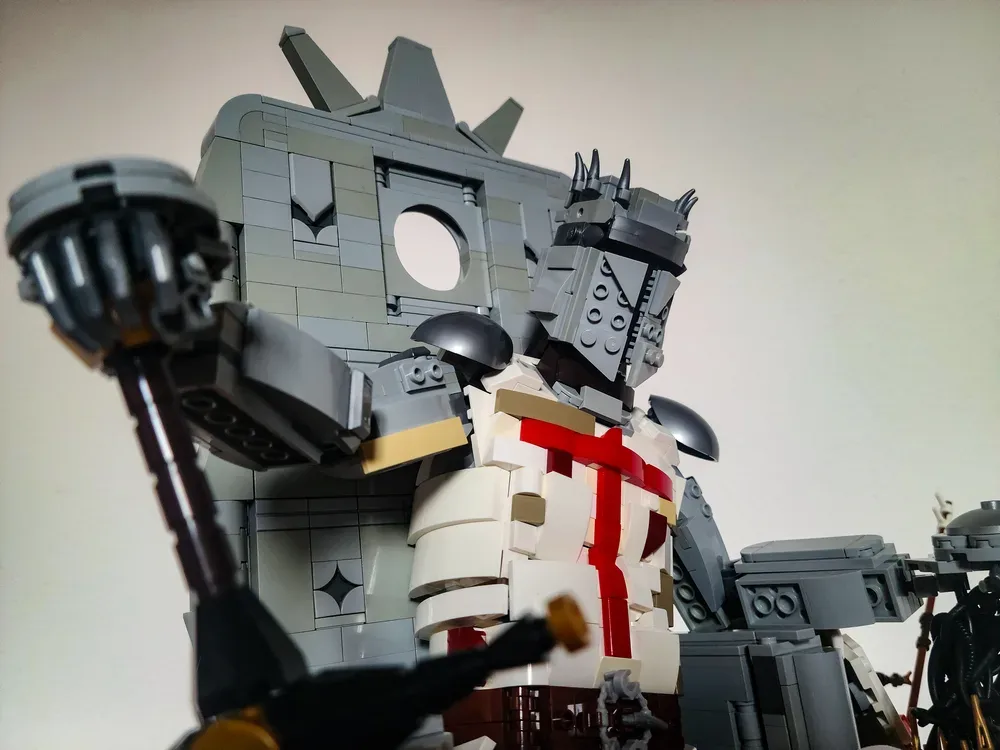
If you’ve seen their recent work, you’ve likely stopped to admire their Templar MOC. It’s moody, it’s intricate, and it feels like a scene pulled directly from a high-stakes cinematic RPG.
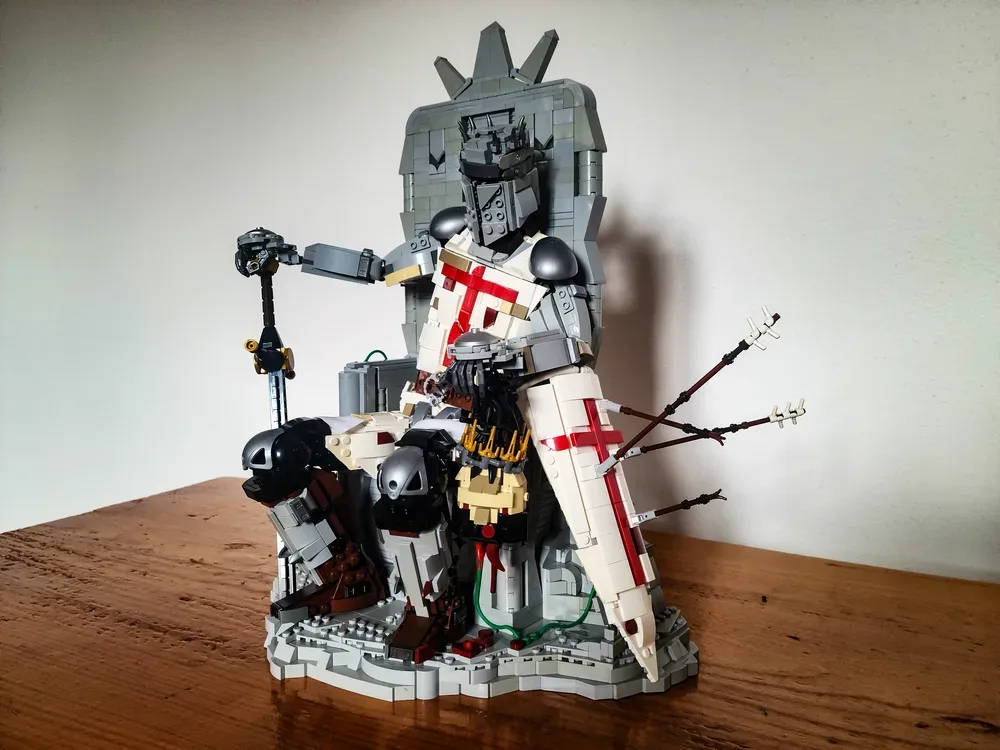
The inspiration for this model didn’t come from a dusty history book or a classic LEGO castle set. It came from a short video clip of a video game cutscene: a knight planting a sword into the ground before ascending to his throne.
It’s a moment of gravitas, and the Beurets saw the potential for a narrative pivot. They not only recreated the clip, but also reinterpreted it, changing the knight’s identity and the story behind the scene. The result is a build that took roughly 12 hours of focused effort. But when you look at it, you realize those 12 hours were packed with technical wrestling.
“The hands of the Templar and the severed head of the king with his hair were the absolute most challenging parts,” they admit. And honestly, it shows. Achieving organic shapes like human hair using only hard plastic elements is nothing short of an achievement in LEGO MOC building. They used flexible bricks to capture the flow of hair on the king’s severed head, a detail that adds a visceral edge to the model.
Furthermore, they utilized SNOT techniques for the helmet. At that scale, getting a helmet to look like metal rather than a blocky stack of bricks is a feat of engineering. They clearly succeeded, creating a silhouette that feels weighted and dangerous.
Advice from the Trenches: Why You Should Just Start
If you’ve been looking at their Instagram and thinking, “I could never build that,” the Beuret brothers have one simple piece of advice: Try it. “Build, deconstruct, rebuild,” they say. “It’s the best way to improve.”
Indeed, it’s easy to look at a finished, polished MOC and forget that there were probably four versions of that build that ended up in the “deconstruct” pile. It’s a process of trial and error. Nobody’s first MOC is their masterpiece. The secret isn’t innate genius; it’s the willingness to fail. Even if the first version is a mess, the act of taking it apart is where the real education happens.
They also encourage looking outward. The brothers want beginners to challenge themselves by using one new technique per build. “Draw inspiration from the techniques used by LEGO designers and especially MOC builders.” This ensures you’re not building in a vacuum. So, scour the web, look at how the pros handle joints, textures, and color-blocking, and then, most importantly, try to apply those lessons in your own way.
They also offer a nugget of wisdom that every aspiring builder should keep in their back pocket: the importance of building the MOC base. What they mean is if you want your MOC to look like a piece of art rather than a loose collection of parts, give it a home first. This bit shouldn’t be an afterthought.
The Swiss LEGO Scene: A Community on the Rise
There’s a genuine thrill in seeing a local hobby culture transform from a niche interest into a full-blown community event. Talking to the brothers, you get the sense that they are living through a changing tide. They are based in Switzerland, a country that, according to them, is starting to become fashionable again in terms of the LEGO hobby.
For a long time, the scene was relatively quiet, but that is changing fast. New specialized stores are popping up, and the number of conventions and competitions is on the rise. For Zéphir and Ulysse, this is a particularly exciting time. They aren’t just building for their own shelves anymore; they are becoming active participants in a community that is starting to take notice.
“We are fortunate to be starting to make ourselves known among Swiss LEGO enthusiasts. So, it’s just the Swiss Lego trend that excites us,” they share. Let this statement be a reminder that no matter where you are in the world, the best part of this hobby is connecting with like-minded individuals and people who understand the specific joy of brick-building.
The brothers aren’t looking to revolutionize the industry or build the world’s largest castle. They’re just looking to see what they can create before the weekend ends. Building is a practice. It’s the sound of bricks clicking together, the frustration of a bad angle, and the relief when it finally holds. For the Beuret brothers, that’s more than enough.
Where to Find Zéphir and Ulysse Beuret
If you want to keep up with Zéphir and Ulysse, you can find them on social media. They are active, they are constantly improving, and they are exactly the kind of builders that make the global MOC community so vibrant.
You can keep an eye on what they’re building next here:
-
Instagram: @brickmania_ch
-
TikTok: @brickmania_ch
