


Thorben Baumheuer is an inspiring MOC designer who views the constraints of the standard LEGO grid as an open invitation for brilliant, boundary-pushing engineering. Bringing a professional carpenter’s eye for structural integrity to the table, he masterfully balances massive triumphs like a fully articulated 3.5kg Godzilla with whimsical, highly creative builds fueled by pure fun. Ultimately, Thorben reminds fellow builders that true mastery comes from honoring your inner child, looking past the blueprints, and finding pure joy in a pile of bricks.
If you spend enough time around adult LEGO hobbyists, you eventually run into two types of people. There are the purists, who have a strict system for everything and get stressed if a single piece is out of alignment. And then there is Thorben Baumheuer.
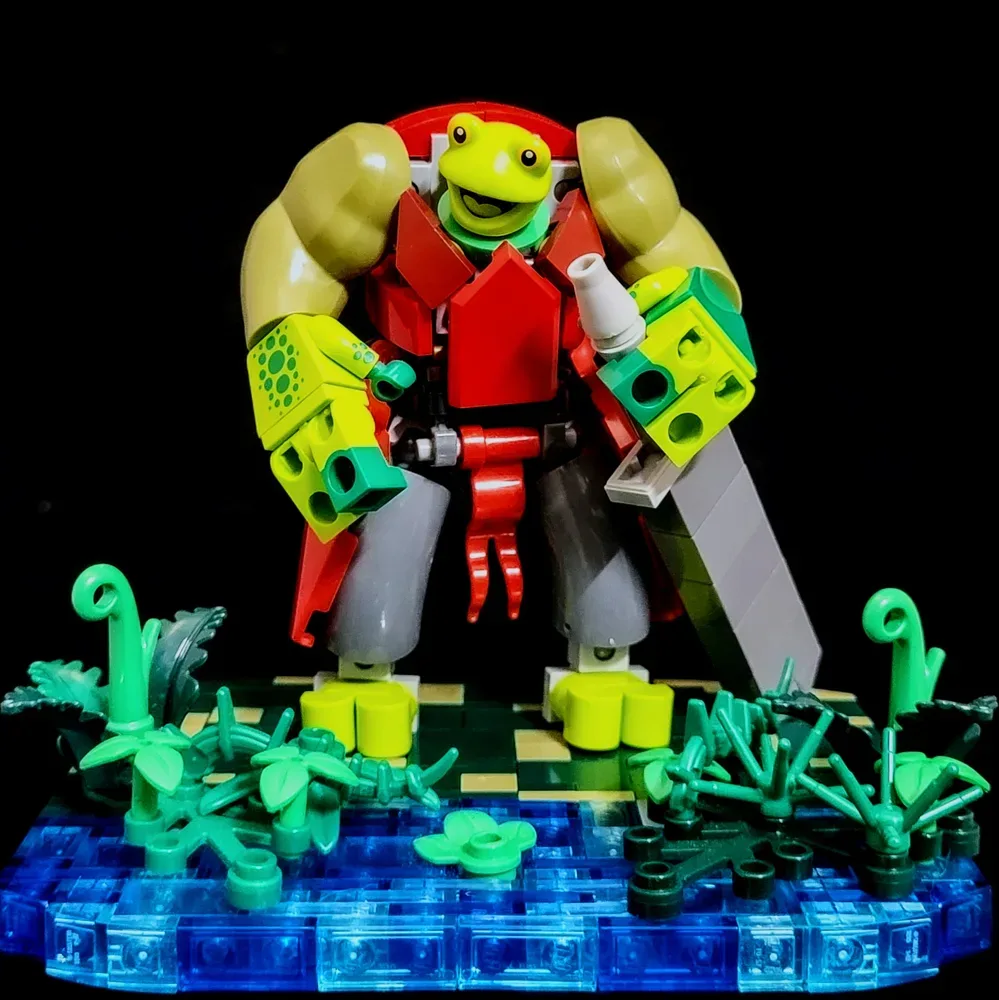
Thorben is the kind of guy who can spend two years obsessing over the structural integrity of a 54-cm-tall Godzilla, yet he is just as happy spending a random Tuesday afternoon turning a CMF frog costume into a hulking, armored frog-knight.
His professional life is rooted in the tangible. He’s a carpenter and a teacher from Germany who now spends his days teaching trade skills to jobless individuals trying to get their lives back on track. Thorben hopes to show them a path toward a new future and carries that same grounded energy into his studio. There is a beautiful symmetry there: he teaches people how to build with wood, and then, he teaches himself how to build with plastic.
We at Bricksly sat down with him to talk about how a guy raising two kids as a single father manages to turn a pile of plastic into things that actually matter.
The Journey from 90s Cartoons to LEGO MOC-Building
To understand Thorben’s art, you have to look at his foundations. Born in the late 80s, he grew up in a world saturated with the vibrant, chaotic energy of 90s cartoons and comics. That sense of imagination seems to have followed him into adulthood.
His LEGO hobby hasn’t been a lifelong, uninterrupted obsession. Yes, he spent plenty of time building as a child, but his path as an adult builder fully unraveled in 2018. It all kickstarted as a response to a need.
When he was in the thick of university and still working part-time in carpentry, Thorben felt a strong urge to create with his hands. So, he immediately bought the LEGO 76107 Thanos: Ultimate Battle set to scratch that itch and satiate his nerdom. “After building it, I immediately tore it apart and built something else from the parts,” he says.
That was the spark. The true obsession arrived a year later. In 2019, he picked up the LEGO 76124 War Machine Buster set and found himself genuinely frustrated by its lack of mobility. The elbows and knees just didn’t move the way he wanted them to.
But instead of complaining, he did what any curious mind would do: he started modding. That, in turn, led him to his first order on BrickLink to source the missing parts. Now that’s the defining trait of his building style: the refusal to leave things as they are.
The most significant shift in his building life came in 2023. After his divorce, Thorben’s daily life drastically changed, with much of his focus now centered on his two daughters. In this new chapter, it became increasingly important to him to pay attention to his own inner child and carve out time each day to nurture his own creative needs.
Brick-building came to his rescue, and what began as a casual hobby, eventually kicked into overdrive. Thorben’s hobby didn’t just survive this transition; it transformed into something more like a lifeline, becoming the safe haven that allowed him to claim a piece of himself and set his mind free.
The Philosophy of the Build: Why He Doesn’t Use Blueprints Anymore
Ask Thorben what drives him to build MOCs, and he’ll tell you it isn’t one thing. It’s a mix of recreation, design challenges, a bit of storytelling, and, of course, the joy of building. He stopped building official sets a long time ago.
At first, it was a money thing. Why pay all that cash for a box of bricks you only build once when you can extend the value by building something new out of it? Over time, that morphed into a creative challenge.
Eventually, Thorben discovered he’s a designer at heart. He’s got an eye for finding creative solutions, and being restricted by the system of the bricks is exactly why he loves it. It’s a puzzle that never truly ends. Today, he rarely buys a set, because the joy of starting from the ground up with a blank slate is far more compelling than following someone else’s blueprints.
Thorben credits Stud.io (BrickLink Studio) as a total gamechanger. Of course, he likes to get his hands dirty first. But while he prefers the experience of putting pieces together physically, he also believes that having the ability to access the entire digital catalog of LEGO parts to experiment with ideas has completely shifted his process.
Now, when you talk to a MOC artist like Thorben, you eventually get to the ‘if you were stranded on a desert island’ question. We asked him which single LEGO part he would choose to have a lifetime supply of. His answer was immediate: d-snots. Having already decimated a massive haul of them through his projects, he knows their value better than most. “I’ve rarely seen a piece more versatile,” he says.
Indeed, for a builder who is constantly fighting against the constraints of the grid, that one small piece is the key to unlocking almost any complex connection he can dream up. It’s the humble, unseen hero of his mechanical designs.
The Ritual of the Night
We all have our building rituals in the LEGO world. For Thorben, it’s strictly post-bedtime. Once the kids are tucked into bed, he doesn’t crash on the sofa, check the phone, or zone out in front of a screen. This is exactly the moment when his real work, or rather, real play begins.
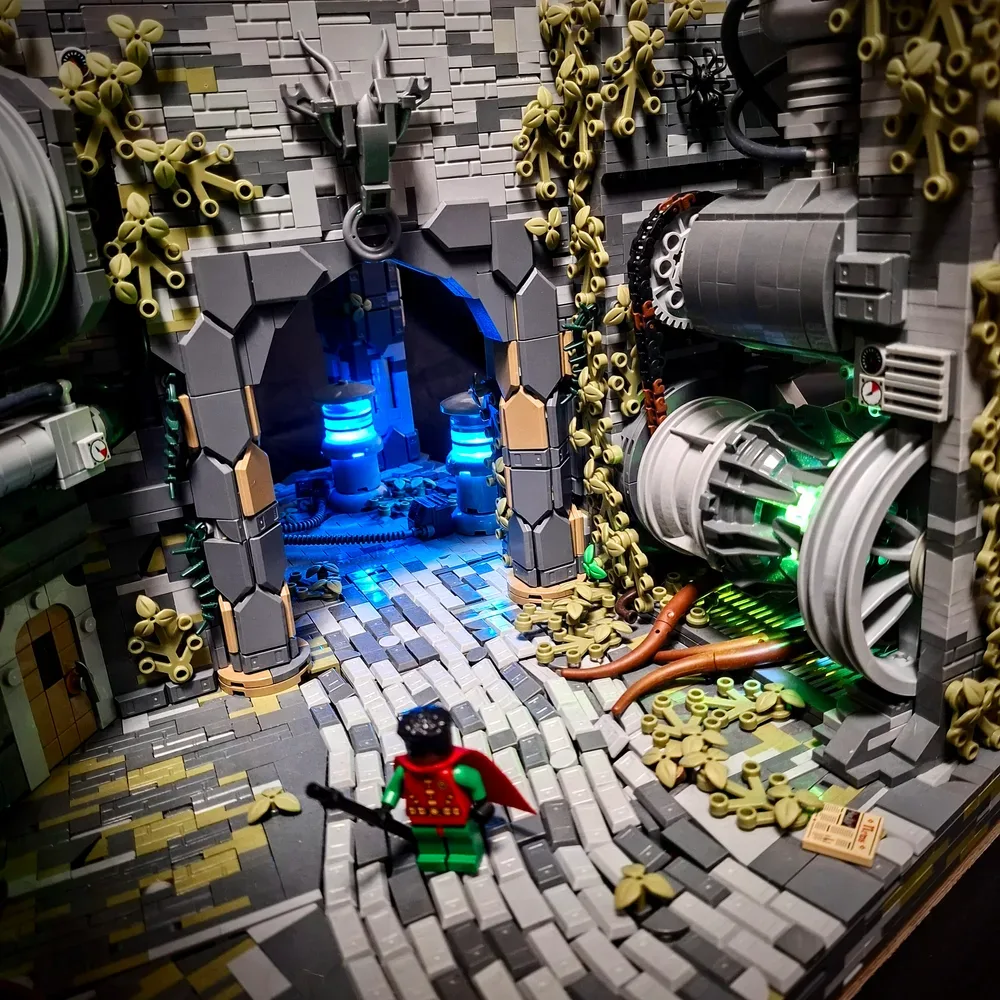
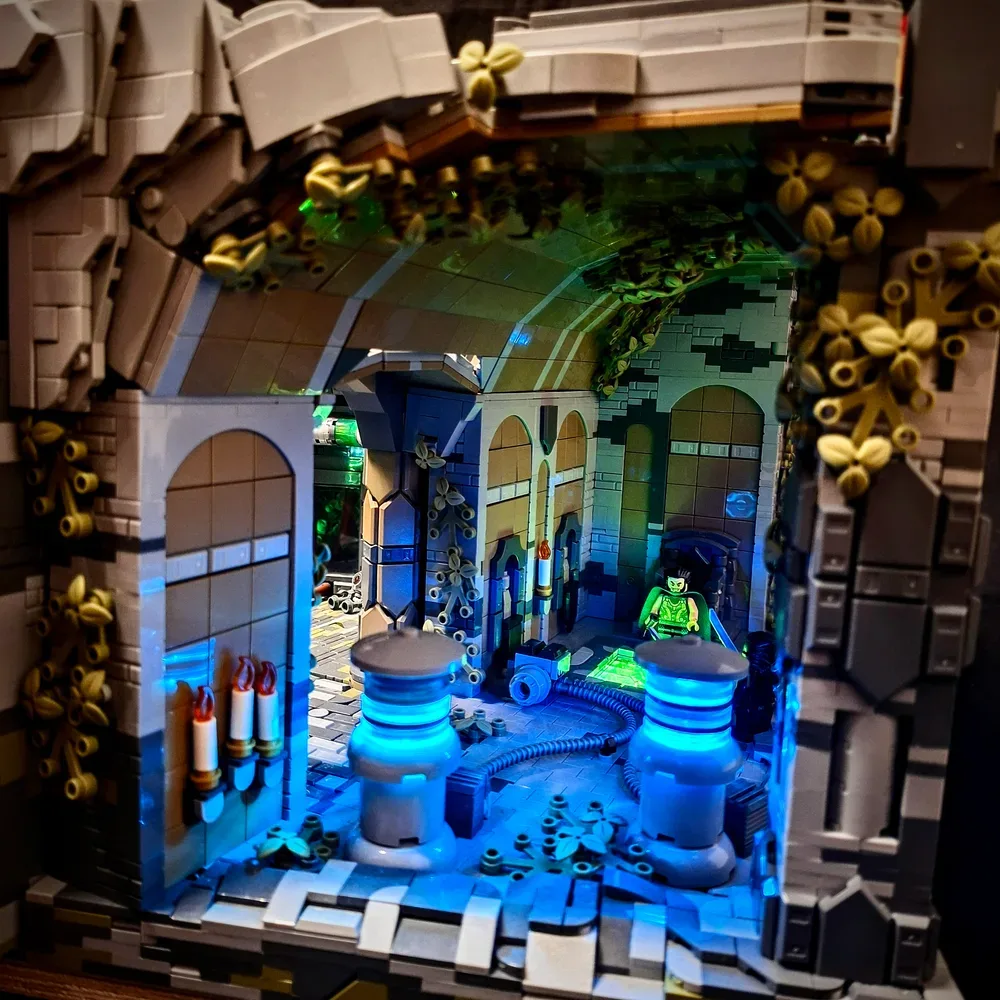
Music is the constant companion of his process — sometimes chosen to set a specific mood, other times just to have a comforting soundtrack in the background. Thorben doesn’t filter his ideas; he builds whatever comes into his head, gravitating more toward creatures, small-scale mechs, and bots. These builds act as a palate cleanser, a distraction while his mind works on much larger, more complex MOCs in the background.
He doesn’t shy away from “stupid” thoughts, even those judged by adult eyes. In fact, he leans into them. For instance, if he has a weird idea, like a mech for a Friends Axolotl, he just rolls with it. It’s a refreshing lack of ego. He isn’t trying to impress the serious adult collectors. He’s doing it for the same reason he loved cartoons in the 90s: because it’s fun.
Thorben’s also a sucker for NPU, finding a genuine thrill in spotting a piece being used in a way it was never intended to be. He loves using small, obscure minifigure parts as detail pieces on his mechs. His Zotaxian Royal Guard and Aquanaut Project Starfish MOCs are proof of that.

To him, the rules of LEGO don’t really exist. He’s the one to tell you: you aren’t bound to the grid. If you stop looking at a 2x4 brick as a floor tile and start looking at it as an engine component, you’re finally starting to build.
When asked about dealing with the inevitable creative wall, Thorben says he doesn’t overthink it. Since his building time is precious and limited, he refuses to force it. If the mood isn’t there, he turns to a movie, a show, or his PS5. The bricks will be there tomorrow.
The Godzilla, Axolotl, and Other MOCs
Thorben’s portfolio of work is a fascinating mix of massive structural challenges and tiny whimsical experiments.
Take his Godzilla project, for instance. It stands out as a personal milestone — a 3.5kg, 54-cm-tall monster that is fully articulated from head to toe. The build took him two years and it’s a masterclass in stability and engineering. The fact that it stands on its own without external support is something he is still proud of today.
Then you look at his Axolotl Mech, which is born from a childlike thought. Thorben pulled it together in just three hours because he felt like it. The variety in his tempo is part of the charm; sometimes a project takes two years, and sometimes it takes a single, focused afternoon.
He finds inspiration in four primary places:
-
Improving existing designs and putting his own twist on them — like his Marvel mechs or DreamZzz MOCs.
-
Reworking childhood themes to physically build the models he imagined as a kid (he was once obsessed with the Slizer theme).
-
Building things he is simply a fan of, like his massive Godzilla and Mothra MOCs.
-
Taking inspiration and re-learning from his own kids, who taught him that it’s okay to not take himself so seriously.
When it comes to building MOCs, Thorben is a realist, not a purist. About 90% of his collection is official LEGO, but he isn’t someone who refuses to use anything else. He lives in a town with a local alt-brand shop where he can buy bricks by the kilo.
He frequently dips into that supply for structural pieces — the bones of his models — where he needs bulk and utility rather than the specific branding on the stud. It’s a practical, carpenter’s approach to building: use the best material for the job, especially when it’s hidden inside the frame of a 3.5kg monster.
When asked what he hopes someone learns from building similar MOCs, his answer is humble: “I hope they have fun.” He doesn’t see himself as an educator, just a fellow builder sharing a path. If someone learns something new along the way, that’s just a bonus.
Advice for the New and Intimidated
If you ask Thorben for advice, he won’t give you a list of fancy building techniques. He’ll tell you to stop comparing yourself to the people on Instagram. For those looking at established MOC artists’ work and feeling like they could never reach that level, he has one piece of advice that hits home: don’t think your builds are inferior to others. As long as you like it, you’re doing it right. Improvement only comes from that baseline of personal enjoyment.
If you are stuck and don’t know how to start, his advice is to limit your scope. Don’t try to build a 3-foot replica of the Titanic on your first try. Build something using the parts from one or two sets, or pick one tiny thing about a set you just built that you didn’t like and try to fix it. That’s how you learn.
And if you’re having a bad day and the bricks just aren’t clicking? Put them away. Go play some PS5. Watch a movie. Don’t force creativity, because that’s when you stop enjoying it. Most importantly, ask for help. Thorben says he’s never met a builder who wouldn’t be happy to share what they know, so his biggest piece of advice is just to ask. Reach out. Be human.

The Takeaway
LEGO MOCist Thorben Baumheuer is a man who builds with intention. As a single father of two adorable girls, his life is a whirlwind of responsibilities. Yet, in the pockets of time he carves out for himself, he finds solace in the geometry of plastic bricks that give him the anchor for personal expression.
He is a builder, an artist, a teacher, and a student of his own process. Thorben isn’t building for fame. He’s building because it’s his version of a conversation with his own imagination. Whether he’s perfecting a giant Godzilla or playing with a frog-knight, his work is proof that the best designs aren’t found in a box; they’re found in the moments we make for ourselves.
He is someone who’s figured out how to keep the fun in LEGO alive. His story will remind you that we don’t need a professional studio or thousands of dollars to create something meaningful. We just need the curiosity and willingness to see the potential in a pile of plastic.