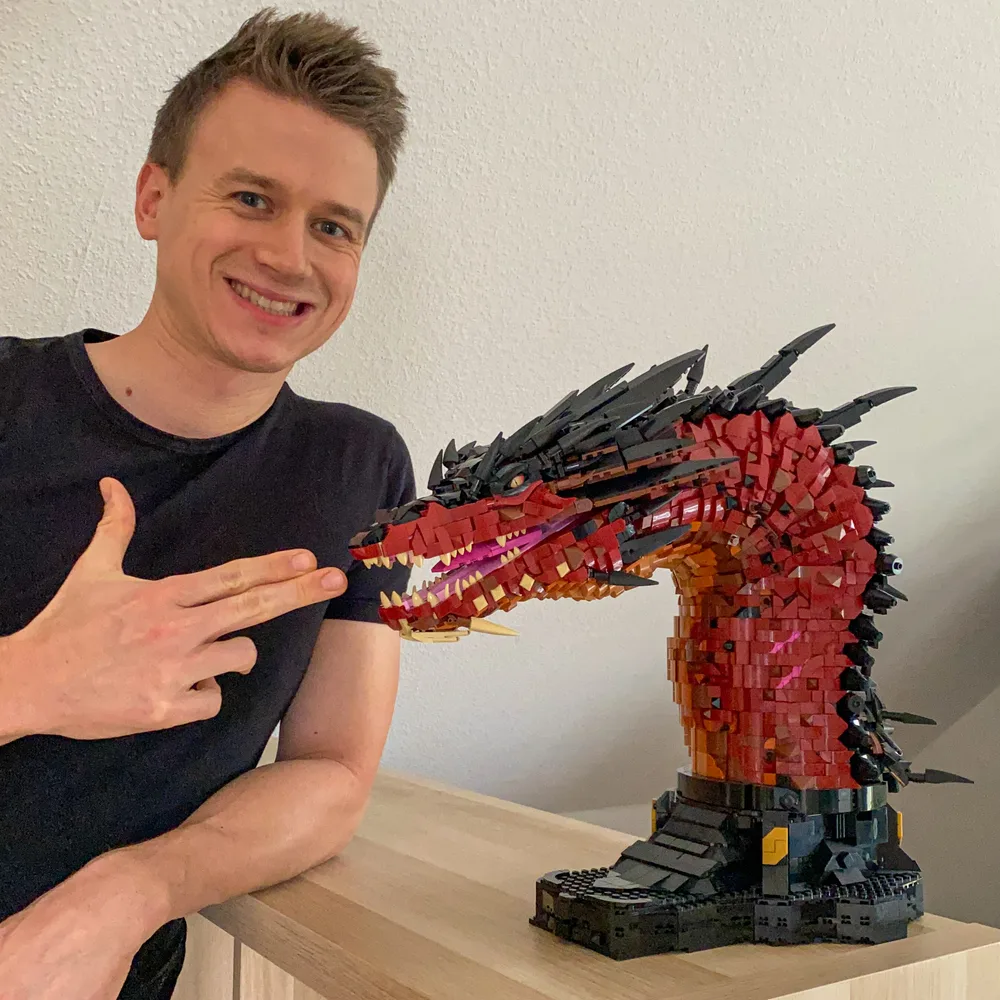

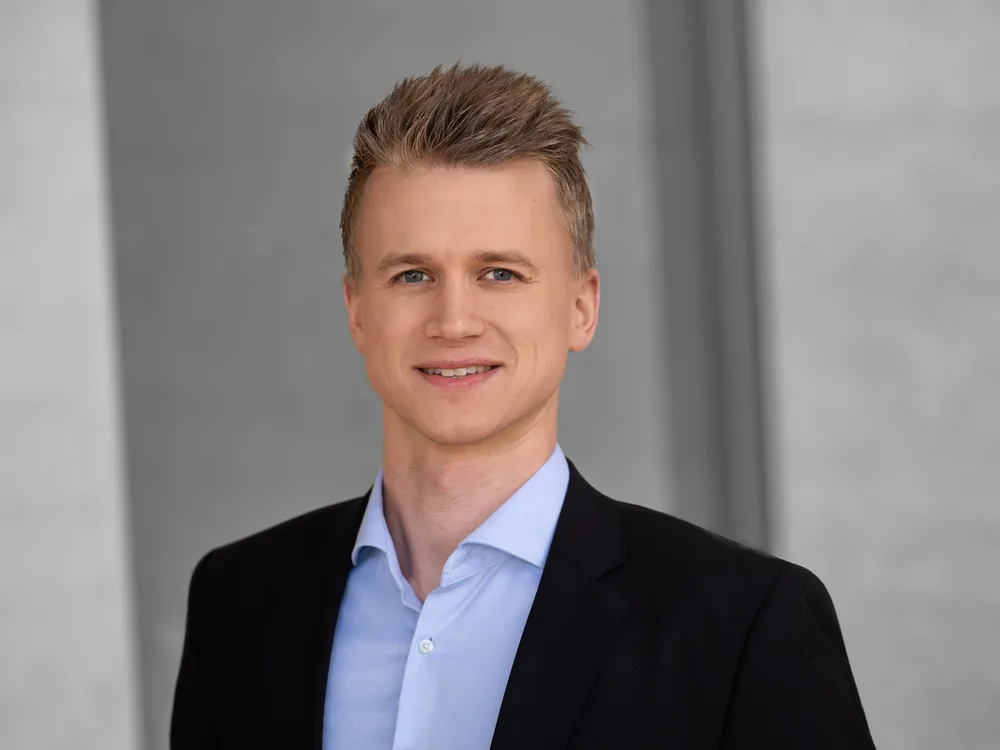
Lukas Koch is a German research engineer holding a Dr.-Ing. who applies machine learning and simulation expertise to the world of custom brick artistry. Merging precise engineering with organic design, he specializes in massive, gravity-defying LEGO MOCs featuring complex curves and specialized angled stability techniques. His standout creation, a massive 3.5 kg Smaug-inspired Fire Dragon Bust, showcases his passion for pushing rigid plastic elements to their absolute physical limits.
There are lives lived in straight lines, and then there are lives that bend, twist, and angle into something entirely unexpected. Lukas Koch, a mechanical and industrial engineer who earned his German Dr. Ing. degree (equivalent to a Ph.D. in engineering), spends his days working in research at Fraunhofer, knee-deep in machine learning and numerical simulation.
His professional world is that of logic and data, and precise calculations. Yet, when he steps away from obligations at work, his mind reaches for calculations measured in plastic studs, tension, gravity, and the untamed shape of a dragon.
To understand how Lukas found his way to building massive, gravity defying brick sculptures, you have to look back thirty years. Like many builders, his journey began within a child’s bedroom in the 1990s. He gravitated toward the classic dinosaur sets of that era, fondly remembering set 5987 (Dino Research Compound) as one of his earliest building memories.
But life happens, and hobbies fade. Lukas drifted into a long dark age, a stretch of fifteen to twenty years where the bricks were packed away, replaced by higher education, career demands, and the steady march of adulthood.
Then came the spring of 2020.
The coronavirus pandemic locked the world indoors, giving people unexpected hours of isolation. For Lukas, that pause in normal life brought him straight back to his childhood passion. He stumbled across some impressive Smaug builds online, which ignited a familiar spark in his mind.
Lukas thought he could do it better, and the pandemic finally gave him the time to try. Soon enough, he began ordering bricks from Bricklink, breathing new life into a pastime he thought he had left behind forever.
An Outlet of Creativity
Why do we build things with bricks? Why does anyone build things with bricks? For some, it’s about killing time; for others, it’s about social connection or simply, the thrill of collecting.
For Lukas, building is a biological necessity. He points to the thoughts of psychologist Jordan Peterson regarding the heavy burden of being creative. If you’ve got a creative mind, you need a valve to let the pressure out. Keep it sealed and it turns inward, making you unhappy.
Building stuff with plastic bricks serves as that exact valve for Lukas. This need for creative release explains why he quickly moved away from premade sets to building MOCs. Following instructions designed by someone else simply couldn’t handle the volume of ideas he wanted to express. The young artist needed the freedom to experiment, to fail, and to discover.
When Lukas is at the table, he doesn’t rely on elaborate rituals. He doesn’t need background music, or a specific hour of the day, or a movie playing in the background. Maintaining focus hasn’t really been a problem for him. His biggest hurdle isn’t a lack of inspiration or hitting a creative wall either.
The only real obstacle is time; Lukas never seems to have enough of it to consistently materialize all the ideas waiting in his head. Honestly, we think that’s a good problem for any LEGO MOCist to have.
The artist further says if he could wish for a single, inexhaustible resource for his workshop, he wouldn’t ask for rare minifigures or specialized molded heads. He wants a lifetime supply of simple 2x4 plates in black. Indeed, in the hands of a master, the most basic elements are always the most powerful.
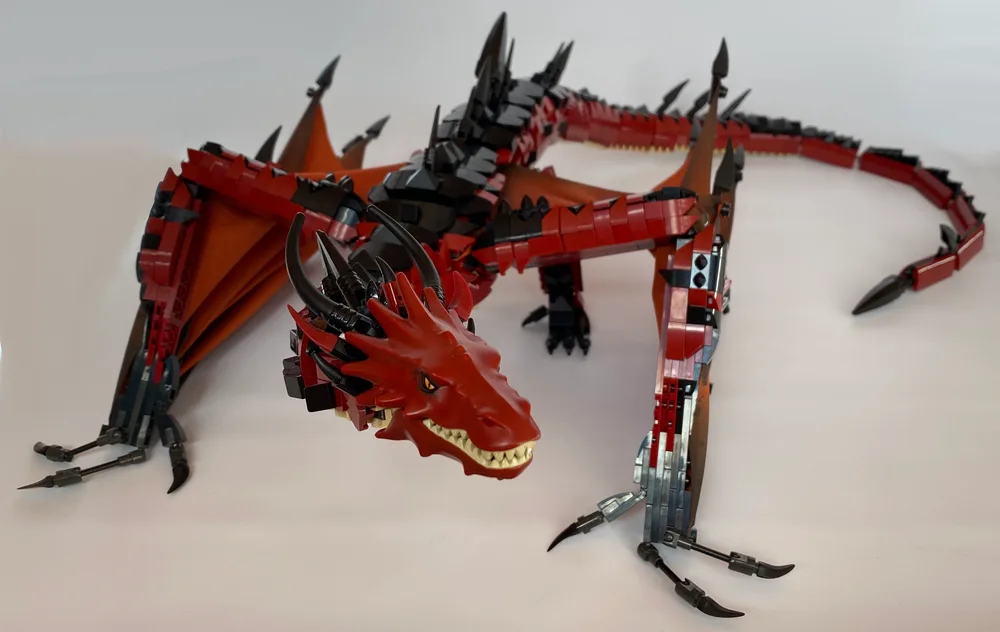
Organic Challenge: The Fire Dragon Bust
Instead of focusing on clean architectural lines, spaceships, or blocky vehicles like most builders, Lukas likes to lean toward something far more difficult — building organic structures.
Replicating the curves and muscles of living creatures using rigid plastic bricks is a hurdle already. Nonetheless, coming up with the required techniques to pull this off is where he finds the true joy of the hobby.
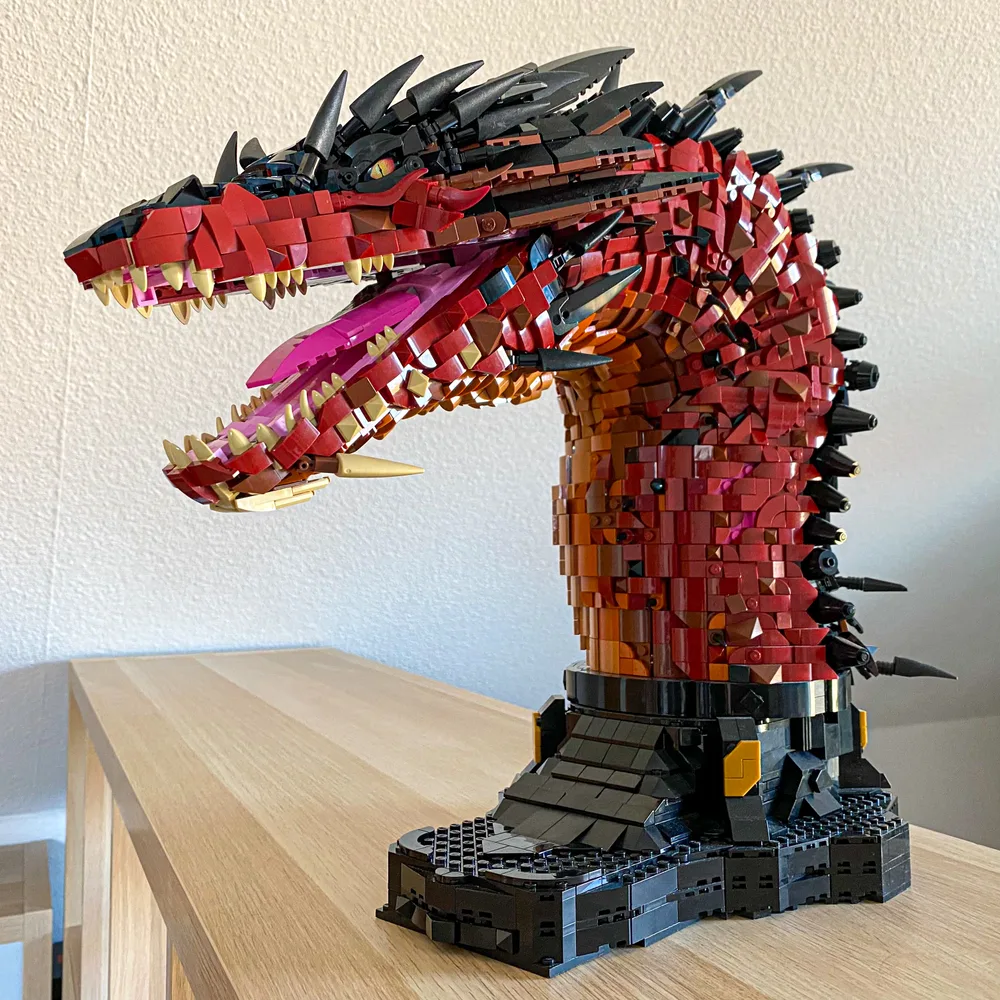
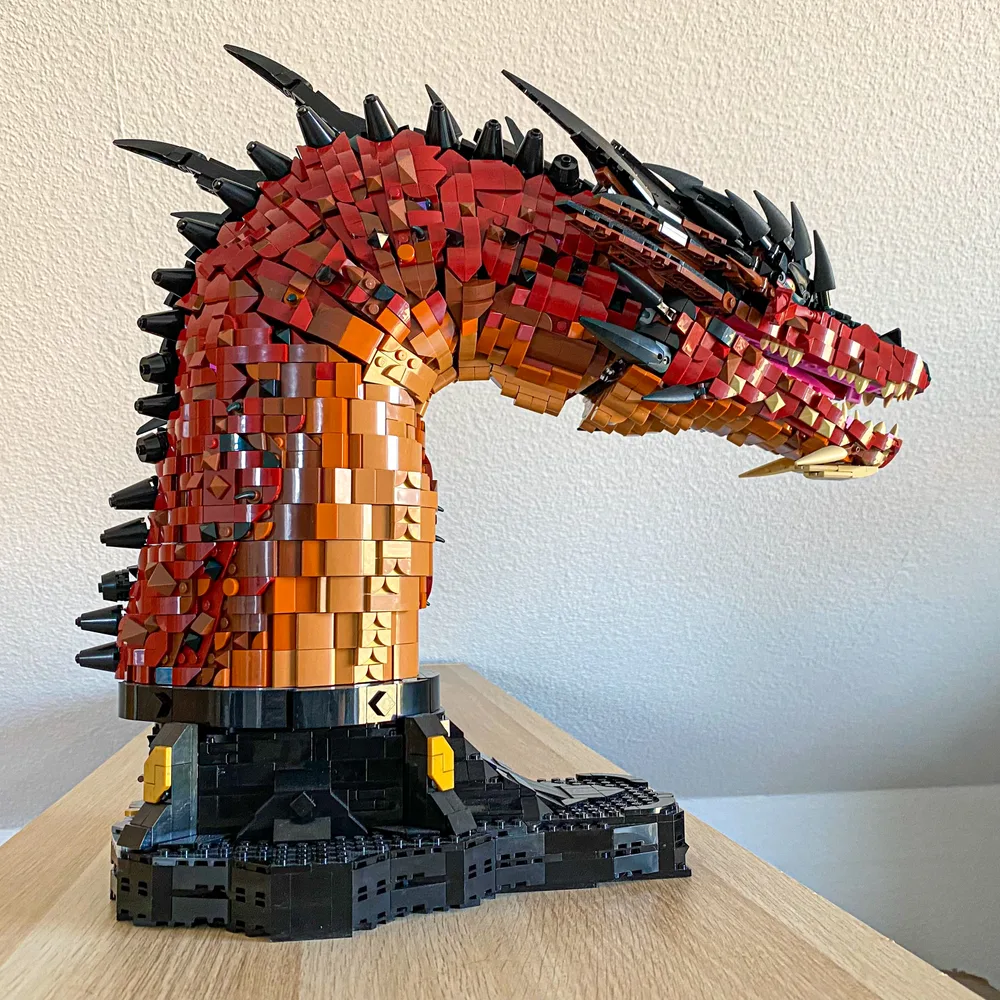
This dedication to organic forms culminates in his standout creation, the Fire Dragon Bust, heavily inspired by Smaug the Terrible. Getting the angles right on a face that twists and breathes was a mighty challenge, but Lukas approached it with enthusiasm.
The journey of this model is a story of trial and error, and stubborn perseverance. The prototype was built using LEGO bricks, sourced largely through Bricklink because of its easy search and order functions. The design has evolved, and the completed model can now be built using non-LEGO bricks as well.
The sheer scale of the project is staggering. While Lukas didn’t keep a strict running clock, the time investment was massive. “The instruction alone did take several hours to make. The prototype itself probably took several thousand hours,” says the artist.
Conquering Gravity
The most formidable enemy Lukas faced during the Fire Dragon Bust project was not design complexity, but simple physics. Plastic bricks are wonderful things, but not engineered to handle massive height and heavy weight balanced at severe angles. Naturally, stability becomes an issue with large builds.
Over 40 cm tall and weighing 3.5 kg, the artist’s build put immense stress on standard connections. “It required some very specific building techniques I couldn’t find anywhere else,” says Lukas. The project took three separate physical prototypes just to find a stable build!
When asked about the secret to his success with the Fire Dragon Bust, Lukas talks about stable angled building techniques. “These allow me to build angles in two spatial directions, creating the required organic shapes for the building,” he says.
The method helps him create the smooth, flowing organic shapes necessary for a creature that looks alive. Lukas notes that these stable angled building techniques remain remarkably unpopular in the broader community, likely because of how frustratingly difficult they are to master.
Despite the hurdles, the artist looks at the modern hobby with optimism. He’s particularly excited by the current trend of big collector sets. He sees them as pieces that stand as a genuine pleasure to watch and display rather than just sitting on a shelf as toys.
Starting the Journey
For anyone sitting across the room, staring at a pile of unsorted pieces while feeling intimidated by the prospect of designing a MOC, Lukas offers straightforward advice: just start building.
Modern brick artists often rely on digital software like Stud.io to plan their creations, but Lukas stresses the value of reality. He recommends doing regular physical prototypes alongside software work to easily figure out which techniques hold together and which collapse under their own weight.
Editor’s Note: To help map out these challenging organic curves before building, you can use our Brick Sculptor tool to visualize complex 3D shapes and calculate brick layers in real time.
Lukas continues to share his journey and his incredible creations with the world. You can find his work on Instagram under the handle @luke_a_art, or view his shared designs and community contributions on his Rebrickable profile.
Whether he’s working at Fraunhofer on advanced engineering problems or sitting at home figuring out how to make plastic scales curve around a dragon’s jaw, LEGO MOC artist Lukas Koch remains true to his nature. He’s a builder who found his valve, letting his creativity pour out one brick at a time.